File:Calcite fluorescing.jpg
| Uploaded by | Ser Amantio di Nicolao |
|---|---|
| Upload date | 2020-11-19T18:17:48Z |
| MIME type | image/jpeg |
| Dimensions | 2304 × 2088 px |
| File size | 3.7 MB |
Summary
| Description |
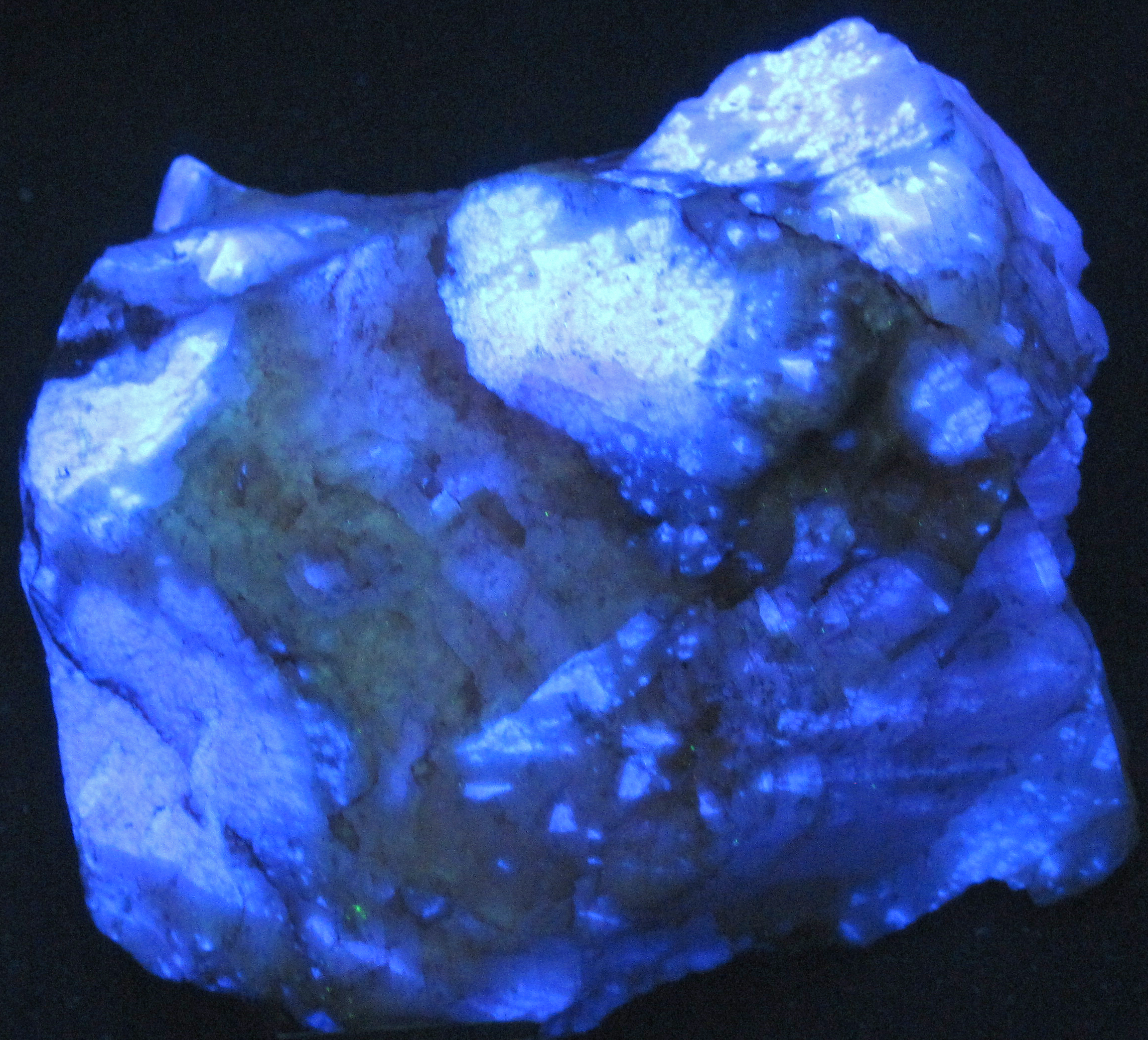
English: Calcite fluorescing under ultraviolet light. (public display, Sternberg Museum of Natural History, Hays, Kansas, USA)
From museum signage: "Fluorescence occurs at the atomic level. We can think of an atom like a miniature solar system. Electrons orbit the nucleus of the atom like planets orbit the sun. Fluorescence is a two-stage process. First, energy from invisible ultraviolet radiation pushes an electron into a higher orbit around its atomic nucleus. The electron loses much of its newly acquired energy as heat to neighboring atoms, making its higher orbit increasingly unstable. Next, when this "excited" electron falls back to its normal "ground state" orbit, it releases the rest of its acquired energy in a sudden burst. Since the electron already lost some of its acquired energy as heat, the burst emitted is a lower energy, longer wavelength visible light. The emitted light is a specific wavelength of pure color, but very dim. It requires about 10 million individual bursts for the human eye to detect the light. Usually, the entire process occurs in a split second. If it takes several seconds or more for electrons to return to ground state after the UV radiation stops, we see it as an afterglow called phosphorescence. Fewer than 15% of minerals fluoresce. In the minerals that do, only a small percentage of the mineral's atoms generate the fluorescence. We call these activator atoms. Activators vary from mineral to mineral or from locality to locality in the same kind of mineral. The color and strength of fluorescence depends on the kinds of activators present, how they interact with neighboring atoms, and the wavelength of the UV radiation that initiates the process. The processes are complex and highly variable. Commonly, activator atoms occur as chemical impurities replacing the normal atoms in a mineral. (Few pure minerals fluoresce.) Fluorescence may require more than one kind of atom to function as co-activators. In such cases, the second impurity absorbs the UV radiation, transfers the absorbed energy to the primary activator atom, which then emits visible light. Sometimes, the presence of certain secondary impurities can function as quenchers. These impurities absorb energy from otherwise potent activator atoms, preventing them from fluorescing. " |
| Date | |
| Source | https://www.flickr.com/photos/47445767@N05/32351691636/ |
| Author | James St. John |
Licensing


- You are free:
- to share – to copy, distribute and transmit the work
- to remix – to adapt the work
- Under the following conditions:
- attribution – You must give appropriate credit, provide a link to the license, and indicate if changes were made. You may do so in any reasonable manner, but not in any way that suggests the licensor endorses you or your use.

|
This image was originally posted to Flickr by James St. John at https://flickr.com/photos/47445767@N05/32351691636. It was reviewed on 19 November 2020 by FlickreviewR 2 and was confirmed to be licensed under the terms of the cc-by-2.0. |