File:PIA22546-Mars-AnnualCO2ice-N&SPoles-20180806.gif
Summary
| Description |
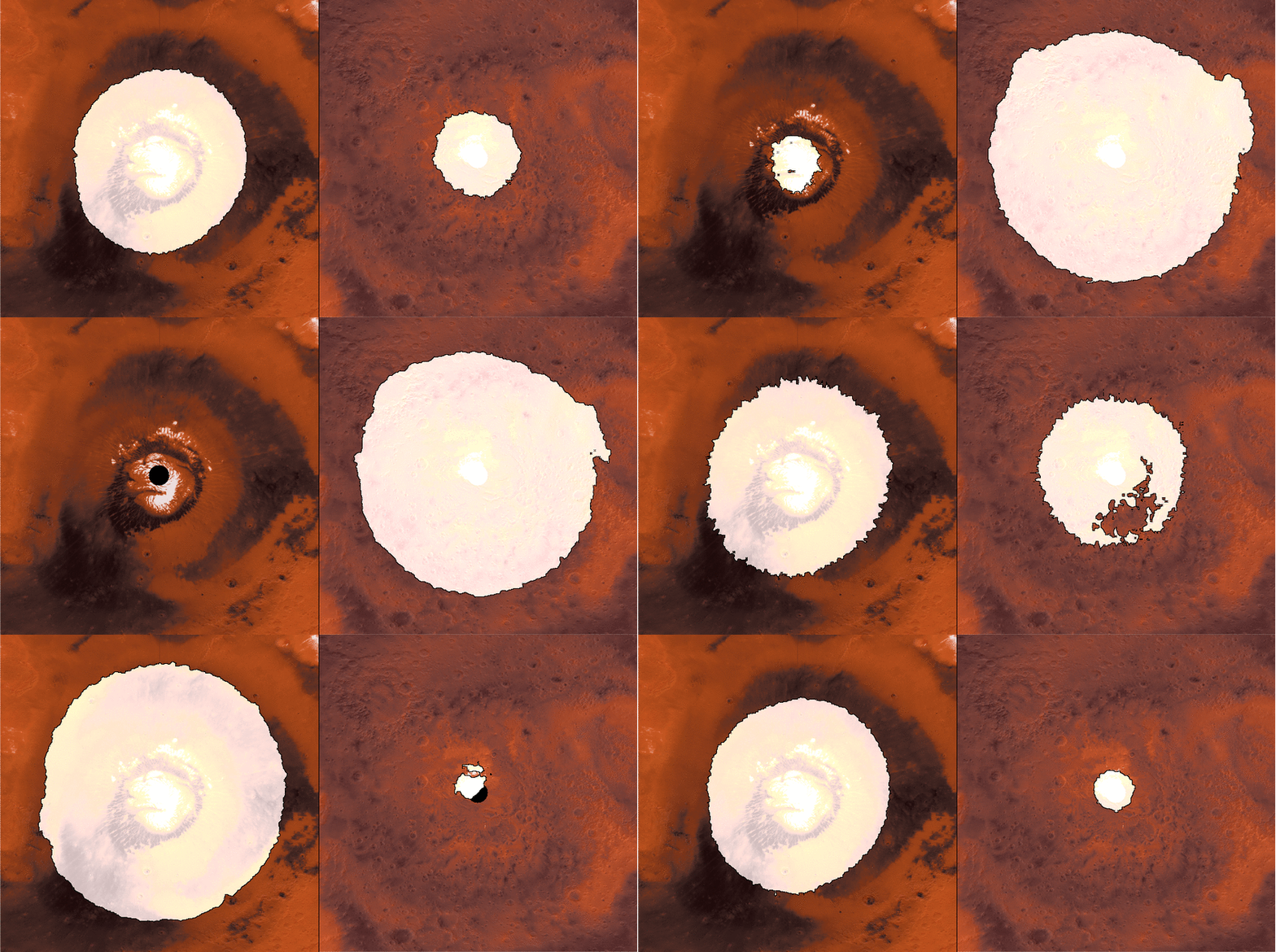
English: PIA22546: Growth and Retreat of the CO2 Ice at the Martian Poles
https://photojournal.jpl.nasa.gov/catalog/PIA22546 This animation shows a side-by-side comparison of CO2 ice at the north (left) and south (right) Martian poles over the course of a typical year (two Earth years). This simulation isn't based on photos; instead, the data used to create it came from two infrared instruments capable of studying the poles even when they're in complete darkness. As Mars enters fall and winter, reduced sunlight allows CO2 ice to grow, covering each pole. While ice at the north pole is fairly symmetrical, it's somewhat asymmetrical during its retreat from the south pole for reasons scientists still don't understand. Scientists are especially interested in studying how global dust events affect the growth and retreat of this polar ice. Mars' seasons are caused by a tilt in the planet, resulting in winter at one of the planet's poles while it's summer at the other. How do spacecraft observe the Martian surface in the polar night, when the Sun is below the horizon for weeks or even months, or in the spring, when it's hazy? They use infrared instruments measuring surface temperatures, even when the ground is in complete darkness or the atmosphere obscured. CO2 ice (sometimes called dry ice) is the coldest material found on Mars, and it is near -193 degrees Fahrenheit (-125 degrees Celsius), whereas ice free soil is generally warmer. As a result, scientists can track the position of the seasonal caps, even in the dark, using surface temperature measurements. Each panel of the animation is about 3,728 miles (6,000 kilometers) across. This data was collected by the Mars Climate Sounder (MCS) instrument on NASA's Mars Reconnaissance Orbiter, and the Thermal Emission Spectrometer (TES) onboard NASA's now defunct Mars Global Surveyor. The MCS data was collected between mid-2006 and the end of 2013; the TES data was collected between early 1999 to late 2006. |
| Date | |
| Source | https://photojournal.jpl.nasa.gov/archive/PIA22546.gif |
| Author | NASA/JPL-Caltech |
Licensing
 |
The copyright holder of this file, NASA/JPL-Caltech, allows anyone to use it for any purpose, provided that the copyright holder is properly attributed. Redistribution, derivative work, commercial use, and all other use is permitted. |
|
|
  |
According to JPL's image use policy additional restriction is that no endorsement of any product or service by Caltech, JPL or NASA is claimed or implied.
Caltech's disclaimer: Caltech makes no representations or warranties with respect to ownership of copyrights in the images, and does not represent others who may claim to be authors or owners of copyright of any of the images, and makes no warranties as to the quality of the images. Caltech shall not be responsible for any loss or expenses resulting from the use of the images, and you release and hold Caltech harmless from all liability arising from such use. Usage on the English Wikipedia: On the English Wikipedia you can use the {{JPL Image}} template to display the copyright notice. (See w:Wikipedia:Using JPL images for details) |