File:Herman-ring-1.png
Summary
| Description |
English: Julia set for rational map with Herman rings.
|
| Date | |
| Source | Own work |
| Author | Ilya Voyager |
Licensing
I, the copyright holder of this work, hereby publish it under the following licenses:


This file is licensed under the Creative Commons Attribution-Share Alike 3.0 Unported, 2.5 Generic, 2.0 Generic and 1.0 Generic license.
- You are free:
- to share – to copy, distribute and transmit the work
- to remix – to adapt the work
- Under the following conditions:
- attribution – You must give appropriate credit, provide a link to the license, and indicate if changes were made. You may do so in any reasonable manner, but not in any way that suggests the licensor endorses you or your use.
- share alike – If you remix, transform, or build upon the material, you must distribute your contributions under the same or compatible license as the original.
 |
Permission is granted to copy, distribute and/or modify this document under the terms of the GNU Free Documentation License, Version 1.2 or any later version published by the Free Software Foundation; with no Invariant Sections, no Front-Cover Texts, and no Back-Cover Texts. A copy of the license is included in the section entitled GNU Free Documentation License. |
You may select the license of your choice.
Compare with :
 better quality image, without src code

Source code
This is a Julia set of the following rational map:
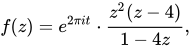


where t=0.6151732.
We used rather straightforward boundary scanning method (see e.g. D. Saupe, Efficient computation of Julia sets and their fractal dimension, Physica D, v.28 n.3, p.358-370, Oct. 1987 [dead link]). C++ source code follows. It's available under CC BY-SA, GFDL and GPLv2+.
See also discussion for some notes about compiling and running the program.

#include <stdlib.h>
#include <math.h>
#include <time.h>
#include <iostream>
#include <complex>

inline double max(double a,double b)
{
	return a>b?a:b;
}

using namespace std;

const double t=0.6151732;
const complex<double> rot=exp(2*M_PI*complex<double>(0,1)*t);//e^{2 \pi i t}

complex<double> f(complex<double> z)
{
//    f(z) = e^{2 \pi i t}\cdot \frac{z^2(z - 4)}{1 - 4z},
	return rot*(z*z*(z-4.))/(complex<double>(1,0)-4.*z);
}

int main()
{
	//z=x+iy;
	double xmin=-4.0,xmax=8.0,deltax,ymin=-3,ymax=3,deltay;
	int precx=400, precy=200;
	deltax=(xmax-xmin)/precx;
	deltay=(ymax-ymin)/precy;
	int iterations=4000;
	double threshold=iterations/30*sqrt(deltax*deltax+deltay*deltay);
	double x,y;

	complex<double> zlt,zlb,zrt,zrb;
	int i,k,l;
	double maxdistance;
	int color, MaxColor=15;
	double infty=1.E4;
	bool inf_zlt,inf_zlb,inf_zrt,inf_zrb;


	cout << "P2" << endl << precx << " " << precy << endl << MaxColor << endl;
	for(k=0;k<precy;k++)
	{
		y=ymax-k*deltay;
		cerr << y << endl;
		for(l=0;l<precx;l++)
		{
			x=xmin+l*deltax;
			zlt=complex<double>(x-deltax/2,y+deltay/2);
			zlb=complex<double>(x-deltax/2,y-deltay/2);
			zrt=complex<double>(x+deltax/2,y+deltay/2);
			zrb=complex<double>(x+deltax/2,y-deltay/2);
			inf_zlt=false;
			inf_zlb=false;
			inf_zrt=false;
			inf_zrb=false;
			for(i=0;i<iterations;i++)
			{
				if(!inf_zlt){zlt=f(zlt);}
				if(!inf_zlb){zlb=f(zlb);}
				if(!inf_zrt){zrt=f(zrt);}
				if(!inf_zrb){zrb=f(zrb);}
				if(abs(zlt)>infty)
				{
					zlt=infty;
					inf_zlt=true;
				}
				if(abs(zrt)>infty)
				{
					zrt=infty;
					inf_zrt=true;
				}
				if(abs(zlb)>infty)
				{
					zlb=infty;
					inf_zlb=true;
				}
				if(abs(zrb)>infty)
				{
					zrb=infty;
					inf_zrb=true;
				}
			}
			maxdistance=max(abs(zlt-zlb),max(abs(zlt-zrt),max(abs(zlt-zrb),max(abs(zlb-zrt),max(abs(zlb-zrb),abs(zrt-zrb))))));
			if(maxdistance>threshold*8)
			{
				color=0;
			}
			else
			{
				if(maxdistance<threshold/8.)
				{
					color=MaxColor;
				}
				else
				{
					color=MaxColor-(int(log(maxdistance/threshold)/log(8)*7.)+7);
                                        				}
			}
			//if (x>0 && y>0) color=MaxColor-color;  /* check the orientation of Z-plane by marking first quadrant */

			cout << color << " ";
		}
		cout << endl;
	}
	return 0;
}