Cognitive model
A cognitive model is an approximation to animal cognitive processes (predominantly human) for the purposes of comprehension and prediction. Cognitive models can be developed within or without a cognitive architecture, though the two are not always easily distinguishable.
History
Earlier diagrams
 Diagram of the Relation of Human and Cosmic Phenomena. 9th century
 Diagram illustrating the relationship of the Planets to the Brain, 1159-75
 Head, showing cells of brain ventricles, c. 1347
 Circles on either side of the head illustrate the four supposed ventricles of the brain, 14th c.
 The brain, and ways of excretion of humours, c. 1428
 The Ventricles, from 1489 to 1503
 Diagram showing the Ventricles of the Brain, 1496
_(14582138630).jpg)
_(14765693511).jpg)

_Wellcome_L0073905.jpg)

_(14582261179).jpg)
_(14765733461).jpg)
16th century
 nl:Jan van Doesborch (1470/80–1536)
 Study of the skull metallic point paper by Leonardo da Vinci, 1510
 Margarita philosophica nova cui insunt sequentia by Gregor Reisch, 1512
 Congestorium artificiose by Johann Romberch, 1533
 Andreas Vesalius' famous De humani corporis fabrica libri septem, published in 1543


17th century
 Robert Fludd (1574 – 1637)
 René Descartes (1596-1650)
 René Descartes (1596-1650)
 Diagram of ventricles of brain by Descartes


18th century
 "Astonishment" from Le Brun, ca 1720
 "Fear" from Le Brun, Characters des passions, circa 1720.
 "Horror" from Le Brun, ca. 1720
 "Sadness" from Le Brun, Characters des passions, circa 1720.
 Characters and Caricaturas by William Hogarth, 1743


19th century
- Phrenology
 Explanation of the new physiognomical system of the brain, 1818
 Symbolical head, After O.S. Fowler, c.1845
 Gustav Scheve, Phrenologische Bilder, 1852-55
 Phrenological organs, 1887


- Other works
 Ernst Mach's Antimetaphysische Vorbemerkungen, 1886

20th century
- Philosophy of mind diagrams
 Turing Test, proposed by Alan Turing, 1936
 Type physicalism, proposed by John Smart and Ullin Place in the 1950s
 Multiple realizability, proposed by Hilary Putnam in the 1960s
 Brain in a vat, proposed by Hilary Putnam (1981)
 Cartesian theater, proposed by Daniel Dennett (1990)


- Diagrams of cognitive models
 Filter Model by Donald Broadbent, 1958-2012
 Baddeley's model of working memory, 1974
 Baddeley and Hitch's working memory model, 1974
 The MARS diagram, 1979
 Baddeley working memory, 1986
 Graphical representation of Flower & Hayes' 1981 model of the cognitive processes involved in writing
 PRS Agent Architecture based on diagram from Georgeff and Ingrand, 1989;
 Model of human information processing after Sanders and McCormick, 1991


21st century
- Philosophy of mind, diagrams
 Neural Correlates of Consciousness, Christof Koch (2004)
 Eight types of consciousness, 2016


- Diagrams of cognitive models
 Categories in the cognitive domain of the revised Bloom's taxonomy (Anderson et al. 2000)
 Fundamental structure of a 4D/RCS control loop, 2002.
 4D-RCS Five levels of the architecture for Demo III, 2002
 Cognitive Theory of Multimedia Learning, (Mayer, 2005)
 Left and Right Brain, (Webber, 2007)
 Cognitive Thought Model (Instructional Design), 2009
 IDA Cognitive Architecture, (Graeme E. Smith 2009)
 Schematic memory, 2009
 abstract and symbolic representation of the term "Bewusstseinsoekologie", 2010
 Modal model of the mind, 2010
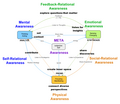 Different forms of Awareness, (Carlo Monsanto, 2011)
 Memory functions, (Bernhard Wenzl, 2011)
 ADDIE Model of Design, 2012


.png)

.jpg)


- Illustrations of the mind
 2010
2010 2011
2011 2013
2013 2015
2015


.jpg)