General maps
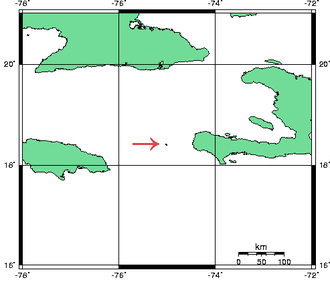 |
Location of Navassa Island |
 |
Map of Navassa Island |
 |
Map of Navassa Island |
In 1504, Christopher Columbus, during his fourth voyage to the New World, was stranded on the island of Jamaica and sent some crew members by canoe to the island of Hispaniola for help. The crew members stopped at Navassa Island on their way but found that there was no water there. They called the island Navaza (from "nava" meaning field or plain), and the island was subsequently avoided by mariners for the next 350 years. Despite Haiti's earlier claim, Navassa Island was claimed for the United States on September 19, 1857, by Peter Duncan, an American sea captain, under the Guano Islands Act of August 18, 1856 for the rich guano deposits found on the island and for its not being under the lawful jurisdiction of any other government or occupied by the citizens of any other government.[4] Haiti protested the U.S. government's annexation, but on July 7, 1858, U.S. President James Buchanan issued an executive order upholding the American claim and called for military action to enforce it. The U.S. government then began its administration of the island as an unincorporated territory of the United States. In 1917, the U.S. Lighthouse Service built a lighthouse on the island.


