plus
English
Etymology
Category:English terms derived from Proto-Indo-European#PLUSCategory:English terms derived from the Proto-Indo-European root *pleh₁-#PLUSBorrowed from LatinCategory:English terms borrowed from Latin#PLUSCategory:English terms derived from Latin#PLUS plūs (“more”).
Pronunciation
- (Received Pronunciation, General American, Canada) IPA(key): /ˈplʌs/Category:English 1-syllable words#PLUSCategory:English terms with IPA pronunciation#PLUS
- (Southern US, fronting) IPA(key): /ˈplɜs/, [ˈplɘ̞s]Category:English 1-syllable words#PLUSCategory:English terms with IPA pronunciation#PLUS
- (General Australian, New Zealand) IPA(key): /ˈplɐs/, [ˈpläs]Category:English 1-syllable words#PLUSCategory:English terms with IPA pronunciation#PLUS
- (Northern England, Ireland, without the foot-strut split) IPA(key): /ˈplʊs/Category:English 1-syllable words#PLUSCategory:English terms with IPA pronunciation#PLUS
- Rhymes: -ʌsCategory:Rhymes:English/ʌs#PLUSCategory:Rhymes:English/ʌs/1 syllable#PLUS
- Hyphenation: plus
Preposition
plusCategory:English lemmas#PLUSCategory:English prepositions#PLUSCategory:English entries with incorrect language header#PLUSCategory:Pages with entries#PLUSCategory:Pages with 16 entries#PLUS
- And; sum of the previous one and the following one.
- Two plus two equals four.Category:English terms with usage examples#PLUS
- A water molecule is made up of two hydrogen atoms plus one of oxygen.Category:English terms with usage examples#PLUS
- (colloquialCategory:English colloquialisms#PLUS) With; having in addition.
- I've won a holiday to France plus five hundred euros in spending money!Category:English terms with usage examples#PLUS
Synonyms
Antonyms
Translations
Conjunction
plusCategory:English lemmas#PLUSCategory:English conjunctions#PLUSCategory:English entries with incorrect language header#PLUSCategory:Pages with entries#PLUSCategory:Pages with 16 entries#PLUS
- And also; in addition; besides (which).
- Let's go home now. It's late, plus I'm not feeling too well.Category:English terms with usage examples#PLUS
Translations
Noun
plus (plural pluses or plusses)Category:English lemmas#PLUSCategory:English nouns#PLUSCategory:English countable nouns#PLUSCategory:English entries with incorrect language header#PLUSCategory:Pages with entries#PLUSCategory:Pages with 16 entries#PLUS
- A positive quantity.
- 2023 April 19, Pip Dunn, “Jack of all trades... and master of most”, in RAIL, number 981, page 57:
- But the pluses far outweigh the criticisms.Category:English terms with quotations#PLUS
- An asset or useful addition.
- He is a real plus to the team.Category:English terms with usage examples#PLUS
- 2000 July 6, N. R. Kleinfield, quoting Dog, “Guarding the Borders Of the Hip-Hop Nation”, in The New York Times, →ISSN, archived from the original on 20 April 2023:
- Look at Trife. He's got two felonies. That means he's finished in society. But he can rap. His two felonies, in rap, man, that's a plus.Category:English terms with quotations#PLUS
- 2021 February 2, Katharine Murphy, “Scott Morrison must heed the lesson of Donald Trump and slap down Craig Kelly”, in The Guardian, archived from the original on 27 April 2021:
- When Morrison mulls the pluses and minuses associated with rebuking Kelly for undermining the government’s public health messaging, the prime minister faces a genuine substantive dilemma, and that goes to the risks of amplification.Category:English terms with quotations#PLUS
- (arithmeticCategory:en:Arithmetic#PLUS) A plus sign: +.
- Abbreviation of LGBT+Category:English abbreviations#PLUS
- (Can we add an example for this sense?)Category:Requests for example sentences in English#PLUS
Synonyms
Antonyms
- (antonym(s) of “useful addition”): liability, minus
- (antonym(s) of “arithmetic: plus sign”): minus, minus sign
Translations
Adjective
plus (not comparable)Category:English lemmas#PLUSCategory:English adjectives#PLUSCategory:English uncomparable adjectives#PLUSCategory:English entries with incorrect language header#PLUSCategory:Pages with entries#PLUSCategory:Pages with 16 entries#PLUS
- Being positive rather than negative or zero.
- −2 * −2 = +4 ("minus 2 times minus 2 equals plus four")
- Positive, or involving advantage.
- He is a plus factor.Category:English terms with usage examples#PLUS
- (physicsCategory:en:Physics#PLUS) Electrically positive.
- A battery has both a plus pole and a minus pole.Category:English terms with usage examples#PLUS
- (postpositive, somewhat informalCategory:English informal terms#PLUS) (Of a quantity) Equal to or greater than; or more; upwards.
- The bus can fit 60 plus kids, but we only get 48.Category:English terms with usage examples#PLUS
- (postpostitive, informalCategory:English informal terms#PLUS) And more.
- 1985 August 10, “Personal advertisement”, in Gay Community News, volume 13, number 5, page 13:
- Have you been to Brazil, Bhutan, or Botswana? Well, I haven't and I'm reday [sic] to go ― almost anywhere interesting actually. Warm, wise world traveler seeks equally exciting, self-sufficient soul for adventures plus.Category:English terms with quotations#PLUS
Synonyms
- (being positive rather than negative or zero): positive
- (positive, involving advantage): advantageous, good, positive
Antonyms
Translations
- The translations below need to be checked and inserted above into the appropriate translation tables. See instructions at Wiktionary:Entry layout § Translations.
Verb
plus (third-person singular simple present pluss or plusses, present participle plusing or plussing, simple past and past participle plused or plussed)Category:English lemmas#PLUSCategory:English verbs#PLUSCategory:English entries with incorrect language header#PLUSCategory:Pages with entries#PLUSCategory:Pages with 16 entries#PLUS
- (informalCategory:English informal terms#PLUS) To add; to subject to addition.
- 1973, Australian Council for Educational Research, ACER research series - Issues 93-95, page 39:
- For him y is a unique number, like 7, but for the time being unknown — if one does the operation of 'plussing 4' one still has, as a result, a unique number even though one does not yet know what it is.Category:English terms with quotations#PLUS
- 1974, Control of Human Behavior: Behavior modification in education:
- The teacher observing the behavior of a child who is plussing or not-plussing is observing instances or not-instances of the concept of plussing.Category:English terms with quotations#PLUS
- (often followed by 'up') To increase in magnitude.
- 2006, Danny Fingeroth, Mike Manley, How to Create Comics: From Script to Print, →ISBN, page 48:
- I am doing a lot of writing here, plussing the script, adding sequences.Category:English terms with quotations#PLUS
- 2009, United States Congress House Committee on Homeland Security, The Direction and Viability of the Federal Protective Service:
- We are losing at the street level a number of officers, but we are plussing up deputy positions.Category:English terms with quotations#PLUS
- 2012, United States Congress House Committee on Armed Services Subcommittee on Military Personnel, Military Retirement Reform, page 24:
- And I believe that, if we can't recognize that in retirement, we ought to recognize it in plussing up hazardous duty pay, plussing up sea duty pay and all those other things that recognize people that don't punch out on Saturday, on Friday afternoon and go home, and just, you know, go day after day after day.Category:English terms with quotations#PLUS
- To improve.
- 1998, Nate Booth, Strategies for Fast-Changing Times, →ISBN, page 91:
- Coach Wooden didn't have to depend upon having the most talented players on his team because he could depend upon plussing to constantly make everyone better.Category:English terms with quotations#PLUS
- 2007, Howard Hendricks, Color Outside the Lines, →ISBN, page 123:
- Keep fooling around with it, improving it, and making it better. You know you have a unique factor when someone steals it. So keep the unique factor unique by constantly plussing it.Category:English terms with quotations#PLUS
- 2004, Pat Williams, Jim Denney, How to Be Like Walt: Capturing the Disney Magic Every Day of Your Life, →ISBN, page 154:
- He was a pioneer in plussing the artform of animated cartoons. He began by plussing Micky Mouse with sound, the plussing the Silly Symphonies with color. Walt plussed the skills of his artists by sending them to art school at his own expense.Category:English terms with quotations#PLUS
- To provide critical feedback by giving suggestions for improvement rather than criticisms.
- 2013, David Burkus, The Myths of Creativity, →ISBN:
- The animators and directors on the receiving end of the plussing don't necessarily have to accept and incorporate the feedback, but plussing provides a method to share criticisms in a way that makes it more likely that they will.Category:English terms with quotations#PLUS
- 2014, Steven Krupp, Paul J.H. Schoemaker, Winning the Long Game: How Strategic Leaders Shape the Future, →ISBN:
- Strategic leaders can adapt the US Army's after-action review and Pixar's plussing technique (where you build on ideas rather than critique and subtract) to show their teams how to learn from mistakes.Category:English terms with quotations#PLUS
- 2014, BusinessNews Publishing, Summary : Little Bets - Peter Sims, →ISBN:
- When people view the early drafts of ideas for their movies under development, they always use plussing to try and come up with suggestions for enhancements. Feedback is always given in an upbeat rather than a derogatory manner.Category:English terms with quotations#PLUS
- (sales) To sell additional related items with an original purchase.
- 1920, The Current Business Cyclopedia: Business Digest:
- Good will is also secured by plussing the original purchase with another article that goes appropriately with it.Category:English terms with quotations#PLUS
- 1986, Max Fallek, How to Set Up and Operate Your Own Law Practice:
- Plussing the original sale creates a win-win situation. The customer benefits because it often saves him the time necessary to run back to the store for overlooked items.Category:English terms with quotations#PLUS
- (psychologyCategory:en:Psychology#PLUS) To frame in a positive light; to provide a sympathetic interpretation.
- 1979, Douglas A. Puryear, Helping People in Crisis, page 87:
- Plussing is a technique for enhancing a positive atmosphere in the session, for diminishing hostility, and for raising self-esteem.Category:English terms with quotations#PLUS
- 1997, Bernard L. Bloom, Planned short-term psychotherapy: a clinical handbook, page 187:
- In addition to active listening as a general therapeutic strategy, Puryear identifies two specific techniques, plussing and paradox, that are used throughout the crisis intervention.Category:English terms with quotations#PLUS
- 2015, Kenneth France, Crisis Intervention, →ISBN, page 177:
- When plussing, the intervenor introduces novel viewpoints that can increase the self-esteem of both the attacker and the target.Category:English terms with quotations#PLUS
- (social mediaCategory:en:Social media#PLUS, datedCategory:English dated terms#PLUS) To give a mark of approval on Google+.
- Coordinate term: like
- 2012, Lee Odden, Optimize, →ISBN, page 111:
- How do you get others to add you or your brand to their circles? By creating and sharing useful content, commenting, plussing others' content and comments, and engaging with others on Google+.Category:English terms with quotations#PLUS
- 2014, Ed Catmull, Creativity, Inc., →ISBN, page 279:
- Everyone was plussing them or liking them or pinning them. The videos went viral.Category:English terms with quotations#PLUS
- (homeopathyCategory:en:Homeopathy#PLUS) To increase the potency of a remedy by diluting it in water and stirring.
- 2005, B. Sahni, Transmission of Homoeo Drug Energy from Distance, →ISBN, page 188:
- On hearing this, plussing was done (all medicated water of the phial was thrown away and fresh distilled was added and 10 strokes were given) on the 13th February 1974.Category:English terms with quotations#PLUS
- 2007, Kate Birch, Vaccine Free Prevention and Treatment of Infectious Contagious Disease with Homeopathy, →ISBN:
- From the remaining water a second dilution can be prepared plussing it to the next slightly higher potency.Category:English terms with quotations#PLUS
- 2011, Kim Lane, Homeopathy for Home: Acute Illness & Injury Care, →ISBN, page 29:
- Plussing is used quite frequently in a patient who's quite sensitive or has an acute problem happening or needs to change his dose or need to take it over several days.Category:English terms with quotations#PLUS
- (optometry) To increase a correction.
- 1976, David M. Worthen, Perry S. Binder, The intraocular lens in perspective, →ISBN, page 2:
- No aspheric cataract spectacle lens designer has ever given the slightest thought to this 4 to 6 diopters of over-plussing for peripheral vision which is responsible for tremendous peripheral distortion, worse peripheral swim, worse false orientation, worse magnification, severe concave curvature of field ("The floor comes up at you"), increased ring scotoma size and increase jack-in-the-box phenomenon (the "horse-blinder effect") with unsafe walking and driving.Category:English terms with quotations#PLUS
Derived terms
- 11-plus examination
- A plus
- check plus
- China plus one
- comedy equals tragedy plus time
- confirm plus chop
- cost plus
- double-plus-good
- double-plus-ungood
- eleven-plus
- eleven plus
- Kleene plus
- minus-plus sign
- mostly plus
- ne plus ultra
- new game plus
- non-plus
- Norway-plus
- on-base plus slugging
- on the plus side
- PALplus
- Parkinson-plus syndrome
- pi-plus
- pi plus
- plus-alpha-pinene
- plus factor
- plus fours
- plus mark
- plus-minus
- plus minus
- plus-minus method
- plus-minus sign
- plus-one
- plus one
- plus or minus
- plus sign
- plus-size
- plus size
- plus-sized
- rien ne va plus
- sex-plus
- softplus
- two plus two equals five
See also
Anagrams
Category:en:Symbols#PLUS Category:English adjectives commonly used as postmodifiers#PLUSCzech
Pronunciation
Conjunction
plusCategory:Czech lemmas#PLUSCategory:Czech conjunctions#PLUSCategory:Czech entries with incorrect language header#PLUSCategory:Pages with entries#PLUSCategory:Pages with 16 entries#PLUS
- plus
- Antonym: minus
- Dva plus dva je čtyři. ― Two plus two equals four.Category:Czech terms with usage examples#PLUS
Noun
plus m inan or nCategory:Czech lemmas#PLUSCategory:Czech nouns#PLUSCategory:Czech entries with incorrect language header#PLUSCategory:Czech masculine nouns#PLUSCategory:Czech inanimate nouns#PLUSCategory:Czech neuter nouns#PLUSCategory:Czech nouns with multiple genders#PLUSCategory:Pages with entries#PLUSCategory:Pages with 16 entries#PLUS
Declension
when masculine:
Indeclinable when neuter.
Related terms
Further reading
- “plus”, in Příruční slovník jazyka českého (in Czech), 1935–1957
- “plus”, in Slovník spisovného jazyka českého (in Czech), 1960–1971, 1989
Dutch
Etymology
Borrowed from LatinCategory:Dutch terms borrowed from Latin#PLUSCategory:Dutch terms derived from Latin#PLUS plūs (“more”).
Pronunciation
- IPA(key): /plʏs/Category:Dutch terms with IPA pronunciation#PLUS
Category:Dutch terms with audio pronunciation#PLUSAudio: (file) - Hyphenation: plus
- Rhymes: -ʏsCategory:Rhymes:Dutch/ʏs#PLUSCategory:Rhymes:Dutch/ʏs/1 syllable#PLUS
Preposition
plusCategory:Dutch lemmas#PLUSCategory:Dutch prepositions#PLUSCategory:Dutch entries with incorrect language header#PLUSCategory:Pages with entries#PLUSCategory:Pages with 16 entries#PLUS
- (arithmeticCategory:nl:Arithmetic#PLUS) plus
- Synonym: en
- Antonyms: min, minus
- Twee plus twee is vier. ― Two plus two is four.Category:Dutch terms with usage examples#PLUS
- plus (having in addition)
Noun
plus m (plural plussen, diminutive plusje n)Category:Dutch lemmas#PLUSCategory:Dutch nouns#PLUSCategory:Dutch nouns with plural in -en#PLUSCategory:Dutch nouns with red links in their headword lines#PLUSCategory:Dutch entries with incorrect language header#PLUSCategory:Dutch masculine nouns#PLUSCategory:Pages with entries#PLUSCategory:Pages with 16 entries#PLUS
Derived terms
Esperanto
Etymology
Ultimately from LatinCategory:Esperanto terms derived from Latin#PLUS plūs (“more”). Doublet of pli and pluCategory:Esperanto doublets#PLUS.
Pronunciation
- IPA(key): /plus/Category:Esperanto 1-syllable words#PLUSCategory:Esperanto terms with IPA pronunciation#PLUS
Category:Esperanto terms with audio pronunciation#PLUSAudio 1: (file)
Category:Esperanto terms with audio pronunciation#PLUSAudio 2: (file) - Rhymes: -usCategory:Rhymes:Esperanto/us#PLUSCategory:Rhymes:Esperanto/us/1 syllable#PLUS
- Syllabification: plus
Preposition
plusCategory:Esperanto lemmas#PLUSCategory:Esperanto prepositions#PLUSCategory:Esperanto entries with incorrect language header#PLUSCategory:Pages with entries#PLUSCategory:Pages with 16 entries#PLUS
- plus
- Antonym: minus
- Du plus du egalas kvar. ― Two plus two equals four.Category:Esperanto terms with usage examples#PLUS
Further reading
- “plus”, in Plena Ilustrita Vortaro de Esperanto [Complete Illustrated Dictionary of Esperanto], 2020, →ISBN
- “plus”, in Reta Vortaro [Online Dictionary] (in Esperanto), 1997-2026
Finnish
Etymology
From LatinCategory:Finnish terms derived from Latin#PLUS plūs.
Pronunciation
- IPA(key): /ˈplus/, [ˈplus̠]Category:Finnish 1-syllable words#PLUSCategory:Finnish terms with IPA pronunciation#PLUS
- Rhymes: -usCategory:Rhymes:Finnish/us#PLUSCategory:Rhymes:Finnish/us/1 syllable#PLUS
- Syllabification(key): plus
- Hyphenation(key): plus
Conjunction
plusCategory:Finnish lemmas#PLUSCategory:Finnish conjunctions#PLUSCategory:Finnish entries with incorrect language header#PLUSCategory:Pages with entries#PLUSCategory:Pages with 16 entries#PLUS
Adjective
plusCategory:Finnish lemmas#PLUSCategory:Finnish adjectives#PLUSCategory:Finnish entries with incorrect language header#PLUSCategory:Pages with entries#PLUSCategory:Pages with 16 entries#PLUS (not inflected)
Derived terms
Further reading
- “plus”, in Kielitoimiston sanakirja [Dictionary of Contemporary Finnish] (in Finnish) (online dictionary, continuously updated), Kotimaisten kielten keskuksen verkkojulkaisuja 35, Helsinki: Kotimaisten kielten tutkimuskeskus (Institute for the Languages of Finland), 2004–, retrieved 3 July 2023
French
Etymology 1
Category:French terms derived from Middle French#PLUSCategory:French terms inherited from Middle French#PLUSCategory:French terms derived from Old French#PLUSCategory:French terms inherited from Old French#PLUSCategory:French terms derived from Old Latin#PLUSCategory:French terms inherited from Old Latin#PLUSCategory:French terms derived from Proto-Italic#PLUSCategory:French terms inherited from Proto-Italic#PLUSCategory:French terms derived from Proto-Indo-European#PLUSCategory:French terms inherited from Proto-Indo-European#PLUSInherited from Middle FrenchCategory:French terms inherited from Middle French#PLUSCategory:French terms derived from Middle French#PLUS plus, from Old FrenchCategory:French terms derived from Old French#PLUS plus.
Pronunciation
- IPA(key): /ply/Category:French 1-syllable words#PLUSCategory:French terms with IPA pronunciation#PLUS in its positive sense if followed by an adjective or an adverb not beginning with a vowel, and always in its negative sense (e.g. il est plus grand que moi, or je n'en peux plus)
- IPA(key): /plyz‿/Category:French terms with IPA pronunciation#PLUS in the case of a liaison, i.e. if followed by an adjective or an adverb beginning with a vowel (e.g. tu dois être plus ambitieux)
- IPA(key): /plys/Category:French 1-syllable words#PLUSCategory:French terms with IPA pronunciation#PLUS in its positive sense, when not followed by an adjective or an adverb (e.g. j'en ai plus que toi or avancez un peu plus, s'il vous plait)
- (Quebec, informal) IPA(key): /py/Category:French 1-syllable words#PLUSCategory:French terms with IPA pronunciation#PLUS in its negative sense.
Category:French terms with audio pronunciation#PLUSAudio; “en plus”: (file)
Adverb
plusCategory:French lemmas#PLUSCategory:French adverbs#PLUSCategory:French entries with incorrect language header#PLUSCategory:Pages with entries#PLUSCategory:Pages with 16 entries#PLUS
- more, -er (used to form comparatives of adjectives and adverbs)
- Ton voisin est plus moche que mon frère. ― Your neighbour is uglier than my brother.Category:French terms with usage examples#PLUS
- Le tien est beaucoup plus grand que le mien. ― Yours is much bigger than mine.Category:French terms with usage examples#PLUS
- Elle est plus belle que sa cousine. ― She is more beautiful than her cousin.Category:French terms with usage examples#PLUS
- Elles sont toutes plus entêtées les unes que les autres. ― They are each more stubborn than the last.Category:French terms with usage examples#PLUS
- Elle le fait plus rapidement que lui. ― She does it more quickly than he does.Category:French terms with usage examples#PLUS
- plus vite ! ― faster!Category:French terms with usage examples#PLUS
- (after a verb) more, -er (indicating a higher degree or quantity)
- Je travaille plus en ce moment. ― I am working more at the moment.Category:French terms with usage examples#PLUS
- Je veux faire plus. ― I want to do more.Category:French terms with usage examples#PLUS
- more (indicating a greater quantity) [with de]
- Elle a plus de chocolat. ― She has more chocolate.Category:French terms with usage examples#PLUS
- Plus de la moitié reste. ― More than half is left.Category:French terms with usage examples#PLUS
- more (supplementary, preceded by de)
- Une heure de plus et il serait mort. ― One more hour and he would be dead.Category:French terms with usage examples#PLUS
- Un kilo de plus, s'il vous plaît. ― One more kilo, please.Category:French terms with usage examples#PLUS
- (preceded by a definite article) the most, -est (used to form superlatives of adjectives and adverbs)
- la plus grande ― the biggestCategory:French terms with usage examples#PLUS
- le plus difficile ― the most difficultCategory:French terms with usage examples#PLUS
- (usually with the negative particle ne, see usage notes below) no longer, not ... any more
- Tu n'existes plus. ― You no longer exist. / You don't exist any more.Category:French terms with usage examples#PLUS
- Il n'y a plus de travail. ― There is no more work.Category:French terms with usage examples#PLUS
- (elliptically, introducing each clause) the more ..., the more ...
- Plus je vois, plus je veux.
- The more I see, the more I want.
- (similarly, used with other comparatives) the more ..., the ...
- Plus j'écoute, moins je comprends.
- The more I listen, the less I understand.
Usage notes
- There may be some difficulty for non-native speakers to detect the negativity or positivity of "plus". The negative sense is generally used with a ne, but the "ne" is sometimes elided or even dropped in colloquial speech. Thus in certain cases, some speakers may choose to pronounce the final /s/ of a positive plus (as /plys/) in order to make a distinction.
Derived terms
Descendants
- Haitian Creole: plis
Noun
plus m (invariable)Category:French lemmas#PLUSCategory:French nouns#PLUSCategory:French countable nouns#PLUSCategory:French indeclinable nouns#PLUSCategory:French entries with incorrect language header#PLUSCategory:French masculine nouns#PLUSCategory:Pages with entries#PLUSCategory:Pages with 16 entries#PLUS
- plus, the symbol +
Etymology 2
See the etymology of the corresponding lemma form.
Pronunciation
Verb
plusCategory:French non-lemma forms#PLUSCategory:French verb forms#PLUSCategory:French entries with incorrect language header#PLUSCategory:Pages with entries#PLUSCategory:Pages with 16 entries#PLUS
- first/second-person singular past historic of plaire
Participle
plus m plCategory:French non-lemma forms#PLUSCategory:French past participle forms#PLUSCategory:French entries with incorrect language header#PLUSCategory:Pages with entries#PLUSCategory:Pages with 16 entries#PLUS
Usage notes
- In modern French, the past participle of plaire is always invariable, because it is always intransitive.
Further reading
- “plus”, in Trésor de la langue française informatisé [Digitized Treasury of the French Language], 2012
German
Pronunciation
Adverb
plusCategory:German lemmas#PLUSCategory:German adverbs#PLUSCategory:German entries with incorrect language header#PLUSCategory:Pages with entries#PLUSCategory:Pages with 16 entries#PLUS
- plus, increased by
- Synonyms: mehr, und
- Antonym: minus
- Vier plus eins ergibt fünf. ― 4+1=5Category:German terms with usage examples#PLUS
See also
Interlingua
Adverb
plus (not comparable)Category:Interlingua lemmas#PLUSCategory:Interlingua adverbs#PLUSCategory:Interlingua entries with incorrect language header#PLUSCategory:Pages with entries#PLUSCategory:Pages with 16 entries#PLUS
- more (used to form comparatives)
le plus
Antonyms
Latin
Etymology
From Old LatinCategory:Latin terms derived from Old Latin#PLUS plous, from Proto-ItalicCategory:Latin terms inherited from Proto-Italic#PLUSCategory:Latin terms derived from Proto-Italic#PLUS *plēōs (after being levelled in favour of the neuter *plowis), from Proto-Indo-EuropeanCategory:Latin terms derived from Proto-Indo-European#PLUS *pleh₁-, *pelh₁u- (“many”). Cognate with Ancient Greek πολύς (polús, “many”), Old English feolo (“much, many”). More at fele. The adverb is an adverbial accusativeCategory:Latin adverbial accusatives#PLUS.
Pronunciation
Adjective
plūs (comparative, neuter plūs)Category:Latin non-lemma forms#PLUSCategory:Latin comparative adjectives#PLUSCategory:Latin entries with incorrect language header#PLUSCategory:Pages with entries#PLUSCategory:Pages with 16 entries#PLUS; third declension
- comparative degree of multus (“many”)Category:Latin comparative adjectives#PLUS
- (in the plural) more (in quantity)
- 165 BCE, Publius Terentius Afer, Hecyra 281:
- Nemini plura acerba credo esse ex amore homini umquam oblata / quam mi.
- 2001 translation by John Barsby
- I don't believe anyone has ever had more anguish inflicted on him by love than I have.
- 2001 translation by John Barsby
- Nemini plura acerba credo esse ex amore homini umquam oblata / quam mi.
- 16 BCE, Ovidius, Amores 3.6.63-64:
- Ilia, pone metus! / tu centum aut plures inter dominabere nymphas; / nam centum aut plures flumina nostra tenent.
- 1914 translation by Grant Showerman, revised by G. P. Goold
- Ilia, lay aside thy fears! Thou shalt be mistress among a hundred nymphs, or more; for a hundred, or more, are the nymphs that dwell in my stream.
- 1914 translation by Grant Showerman, revised by G. P. Goold
- Ilia, pone metus! / tu centum aut plures inter dominabere nymphas; / nam centum aut plures flumina nostra tenent.
- (in the plural) several, many
- c. 4 BCE – 65 CE, Seneca Minor, Epistulae Morales ad Lucilium 1.2.5:
- Hoc ipse quoque faciō: ex plūribus quae lēgī, aliquid apprehendō.
- This I myself also do: from the many [things] which I have read, I obtain something [to reflect upon].
- Hoc ipse quoque faciō: ex plūribus quae lēgī, aliquid apprehendō.
- c. 56 CE – 117 CE, Tacitus, Annals 3.34.25:
- Vix praesenti custodia manere inlaesa coniugia: quid fore si per pluris annos in modum discidii oblitterentur?
- (please add an English translation of this quotation)
- Vix praesenti custodia manere inlaesa coniugia: quid fore si per pluris annos in modum discidii oblitterentur?
- 23 BCE – 13 BCE, Horatius, Carmina 1.11, (5th Asclepiad):
- Seu plūrīs hiemēs seu tribuit Juppiter ultimam,
quae nunc oppositīs dēbilitat pūmicibus mare
Tyrrhēnum, sapiās, vīna liquēs et spatiō brevī
spem longam resecēs.- (please add an English translation of this quotation)
- Seu plūrīs hiemēs seu tribuit Juppiter ultimam,
- (in the singular, New LatinCategory:New Latin#PLUS) more, additional
- Synonym: largior
- 1618, Isaac Beeckman, Journal, page 106 recto; quoted in Charles Adam and Paul Tannery, Œuvres de Descartes, Paris: Léopold Cerf, 1908, page 221, footnote c:
- Eodem modo quo spatium multiplicatur, etiam impedimentum multiplicatur, si intelligas in aere vel aqua, id est in pleno, quicquam cadere. Res enim cadens descibit figuram oblongam, lineis omnibus parallelam; cùm res secundâ horâ velocius cadit, plusque spacij percurrat, ea est proportio figuræ quam primâ horâ describit ad eam quam describit secundâ horâ, ut spacium primâ horâ peragratum ad secundâ horâ peragratum. Si igitur res cadens ab impedimento non impediretur, tanto pluri aeri secundâ horâ occurreret, quanto majus est secundæ horæ paralelipipedum, quàm primæ horæ.Category:Latin terms with quotations#PLUSCategory:Requests for translations of Latin quotations#PLUS
- (please add an English translation of this quotation)
- 1764, Francisco Puente, Ars Hippocratica, vel Hippocrates Extractus a Practico Celtibero, page 20:
- Sudor multus ex somno factus sine causa manifesta, corpus uti plure cibo significat; si autem non, evacuatione indiget.Category:Latin terms with quotations#PLUS
- Much sweat made in sleep without a clear cause means that the body uses more food; but if not, it needs evacuation.
- (in the plural) more (in quantity)
Usage notes
- In classical Latin, always plural when used as an adjective. The neuter singular plūs, inflected from the same stem, is used only as a pronoun or adverb. To express "more" of a singular noun denoting an uncountable substance, the pronoun plūs is used with the genitive singular of the noun: e.g. plūs aquae "more water", literally "more of water", plūs āeris "more air", literally "more of air".
- The word maior (“greater”), the comparative of magnus, is used to express greater magnitude, and is sometimes used in contexts where English might use "more" (e.g. maior pecūnia "more money; a greater sum",[1] maiōre vī "with more/greater force", maiōre spatiō temporis "more time; a greater interval of time").
Declension
Irregular third-declension comparative adjective, plural-only in Classical Latin.
| singular | plural | ||||
|---|---|---|---|---|---|
| masc./fem. | neuter | masc./fem. | neuter | ||
| nominative | — | plūs1 | plūrēs | plūra | |
| genitive | plūris1 | plūrium | |||
| dative | plūrī1 | plūribus | |||
| accusative | plūrem1 | plūs1 | plūrēs plūrīs |
plūra | |
| ablative | plūrī1 plūre1 |
plūribus | |||
| vocative | — | plūs1 | plūrēs | plūra | |
1None of the singular forms are used as adjectives in Classical Latin.
Derived terms
Pronoun
plūs (neuter plūs)Category:Latin lemmas#PLUSCategory:Latin pronouns#PLUSCategory:Latin third declension pronouns#PLUSCategory:Latin third declension pronouns of one termination#PLUSCategory:Latin entries with incorrect language header#PLUSCategory:Pages with entries#PLUSCategory:Pages with 16 entries#PLUS; third-declension neuter pronoun
- more; more of
- 84 BCE, Cicero, De inventione 1.88:
- "Cum dicebas: Si indigetis pecuniae, pecuniam non habetis, hoc intellegebam: Si propter inopiam in egestate estis, pecuniam non habetis, et idcirco concedebam; cum autem hoc sumebas: Indigetis autem pecuniae, illud accipiebam: Vultis autem pecuniae plus habere. Ex quibus concessionibus non conficitur hoc: Pauperes igitur estis; conficeretur autem, si tibi primo quoque hoc concessissem, qui pecuniam maiorem vellet habere, eum pecuniam non habere."
- 1949 translation by H. M. Hubbell
- "When you said, 'If you want money, you do not have money,' I understood it to mean, 'If on account of poverty you are in extreme want, you do not have money,' and therefore I granted the point; when, however, you said, 'You do want money,' I took that to mean 'You do want to have more money.' From this admission it does not follow that you are poor. It would follow, if at first I had made this admission also, 'Whoever wishes to have more money, does not have money.'"
- 1949 translation by H. M. Hubbell
- "Cum dicebas: Si indigetis pecuniae, pecuniam non habetis, hoc intellegebam: Si propter inopiam in egestate estis, pecuniam non habetis, et idcirco concedebam; cum autem hoc sumebas: Indigetis autem pecuniae, illud accipiebam: Vultis autem pecuniae plus habere. Ex quibus concessionibus non conficitur hoc: Pauperes igitur estis; conficeretur autem, si tibi primo quoque hoc concessissem, qui pecuniam maiorem vellet habere, eum pecuniam non habere."
- 27 BCE – 25 BCE, Titus Livius, Ab Urbe Condita 7.41:
- Itaque cum hoc unum propter Salonium ab senatu non impetraretur, tum Salonius obtestatus patres conscriptos ne suum honorem pluris quam concordiam civitatis aestimarent, perpulit ut id quoque ferretur.
- 1924 translation by B. O. Foster
- And so, when this one provision would have failed of enactment by the senate, out of consideration for Salonius, he himself besought the Fathers not to think more highly of his distinction than of harmony in the state, and induced them to pass this also.
- 1924 translation by B. O. Foster
- Itaque cum hoc unum propter Salonium ab senatu non impetraretur, tum Salonius obtestatus patres conscriptos ne suum honorem pluris quam concordiam civitatis aestimarent, perpulit ut id quoque ferretur.
- 4 CE – c. 70 CE, Columella, De Arboribus 10.4.6:
- Sed quaecumque in clivis erunt positae, ita ablaqueandae sunt, ut a superiore parte secundum codicem lacusculi fiant, ab inferiore autem pulvilli altiores excitentur, quo plus aquae limique contineant.
- 1955 translation by E. S. Forster, Edward H. Heffner
- But any vines which are planted on slopes must be trenched in such a way that pools may be formed on the higher ground next the stem, and ridges raised to a greater height on the lower ground, so as to contain more water and mud.
- 1955 translation by E. S. Forster, Edward H. Heffner
- Sed quaecumque in clivis erunt positae, ita ablaqueandae sunt, ut a superiore parte secundum codicem lacusculi fiant, ab inferiore autem pulvilli altiores excitentur, quo plus aquae limique contineant.
- 1271 – 1272, Thomas Aquinas, In decem libros Ethicorum expositio book 8.lectio 13.n. 7:
- Illi enim qui utuntur se invicem ad utilitatem, semper pluri indigent quam eis detur, et existimant quod minus recipiant quam eis conveniat.
- For those who use each other for benefit always want more than is given to them, and think that they receive less than is suitable for them.
- Illi enim qui utuntur se invicem ad utilitatem, semper pluri indigent quam eis detur, et existimant quod minus recipiant quam eis conveniat.
Usage notes
- Can be used with a partitive genitive to express "more of" or with quam to express "more than".
- In classical Latin, primarily used in the nominative/accusative, or in the genitive to express value. The ablative singular form plūre could also be used to express value in early Latin, but only a few attestations of this exist,[2] and it may have become archaic in Classical Latin.[3]
- In postclassical Latin, the ablative singular is sometimes plūrī instead of plūre.
Declension
Third-declension pronoun (neuter, i-stem, no dative singular, ablative singular in -e or occasionally -ī), singular only.
Adverb
plūs (comparative)Category:Latin non-lemma forms#PLUSCategory:Latin comparative adverbs#PLUSCategory:Latin entries with incorrect language header#PLUSCategory:Pages with entries#PLUSCategory:Pages with 16 entries#PLUS
- comparative degree of multō (“by much, by far”)Category:Latin comparative adverbs#PLUS: further (more in extent)
- Synonym: magis (magis indicates more in degree')
- Plus ultra! = "Further beyond!" (this is the national motto of Spain)
Descendants
- Italo-Dalmatian:
- Rhaeto-Romance:
- Gallo-Italic:
- Gallo-Romance:
- Ibero-Romance:
- Insular Romance:
- Borrowings:
See also
References
- ↑ Fischer, Gustavus (1897), Latin Grammar Together with a Systematic Treatment of Latin Composition, page 210
- ↑ Hime, Maurice C. (1890), An Introduction to the Latin Language..., page 279
- ↑ Andrews, E. A.; Stoddard, S. (1851), A Grammar of the Latin Language; for the Use of Schools and Colleges., 18th edition, page 59
Further reading
- “multus” in volume 8, column 1606, line 32 in the Thesaurus Linguae Latinae (TLL Open Access), Berlin (formerly Leipzig): De Gruyter (formerly Teubner), 1900–present
- “plus”, in Charlton T. Lewis and Charles Short (1879), A Latin Dictionary, Oxford: Clarendon Press
- “plus”, in Charlton T. Lewis (1891), An Elementary Latin Dictionary, New York: Harper & Brothers
- "plus", in Charles du Fresne du Cange, Glossarium Mediæ et Infimæ Latinitatis (augmented edition with additions by D. P. Carpenterius, Adelungius and others, edited by Léopold Favre, 1883–1887)
- “plus”, in Gaffiot, Félix (1934), Dictionnaire illustré latin-français, Hachette.
- Carl Meißner; Henry William Auden (1894), Latin Phrase-Book, London: Macmillan and Co.
- twenty years and more: viginti anni et amplius, aut plus
- one, two, several days had passed, intervened: dies unus, alter, plures intercesserant
- to expend great labour on a thing: egregiam operam (multum, plus etc. operae) dare alicui rei
- to discuss a subject more fully on the same lines: plura in eam sententiam disputare
- to give a full, detailed account of a thing: pluribus verbis, copiosius explicare, persequi aliquid
- to possess great political insight: plus in re publica videre
- to say nothing further on..: ut plura non dicam
- in short; to be brief: ne multa, quid plura? sed quid opus est plura?
- more of this another time: sed de hoc alias pluribus
- twenty years and more: viginti anni et amplius, aut plus
Middle French
Alternative forms
Etymology
Inherited from Old FrenchCategory:Middle French terms inherited from Old French#PLUSCategory:Middle French terms derived from Old French#PLUS plus, from LatinCategory:Middle French terms derived from Latin#PLUS plūs.
Adverb
plusCategory:Middle French lemmas#PLUSCategory:Middle French adverbs#PLUSCategory:Middle French entries with incorrect language header#PLUSCategory:Pages with entries#PLUSCategory:Pages with 16 entries#PLUS
Descendants
- French: plus
Old French

Etymology
From LatinCategory:Old French terms inherited from Latin#PLUSCategory:Old French terms derived from Latin#PLUS plūs.
Adverb
plusCategory:Old French lemmas#PLUSCategory:Old French adverbs#PLUSCategory:Old French entries with incorrect language header#PLUSCategory:Pages with entries#PLUSCategory:Pages with 16 entries#PLUS
Descendants
- Middle French: plus, plꝰ (abbreviation)
- French: plus
- Norman: pus (Jersey)
Old Occitan
Etymology
From LatinCategory:Old Occitan terms inherited from Latin#PLUSCategory:Old Occitan terms derived from Latin#PLUS plūs.
Adverb
plusCategory:Old Occitan lemmas#PLUSCategory:Old Occitan adverbs#PLUSCategory:Old Occitan entries with incorrect language header#PLUSCategory:Pages with entries#PLUSCategory:Pages with 16 entries#PLUS
- more
- 12th century,. Bernard de Ventadour, Lancan folhon bosc e jarric
- ome de me no vei plus ric
- I do not see a richer [more rich] than me
- 12th century,. Bernard de Ventadour, Lancan folhon bosc e jarric
Descendants
Polish
Pronunciation
Noun
plus m inanCategory:Polish lemmas#PLUSCategory:Polish nouns#PLUSCategory:Polish entries with incorrect language header#PLUSCategory:Polish masculine nouns#PLUSCategory:Polish inanimate nouns#PLUSCategory:Pages with entries#PLUSCategory:Pages with 16 entries#PLUS
Declension
Further reading
Romanian
Etymology
Borrowed from LatinCategory:Romanian terms borrowed from Latin#PLUSCategory:Romanian terms derived from Latin#PLUS plūs. First attested in the early 19th century, acquiring non-mathematical senses by the middle of that century.
Pronunciation
Conjunction
plusCategory:Romanian lemmas#PLUSCategory:Romanian conjunctions#PLUSCategory:Romanian entries with incorrect language header#PLUSCategory:Pages with entries#PLUSCategory:Pages with 16 entries#PLUS
Noun
plus n (plural plusuri)Category:Romanian lemmas#PLUSCategory:Romanian nouns#PLUSCategory:Romanian nouns with red links in their headword lines#PLUSCategory:Romanian countable nouns#PLUSCategory:Romanian entries with incorrect language header#PLUSCategory:Romanian neuter nouns#PLUSCategory:Pages with entries#PLUSCategory:Pages with 16 entries#PLUS
Derived terms
Further reading
- “plus”, in DEX online—Dicționare ale limbii române (Dictionaries of the Romanian language) (in Romanian), 2004–2026
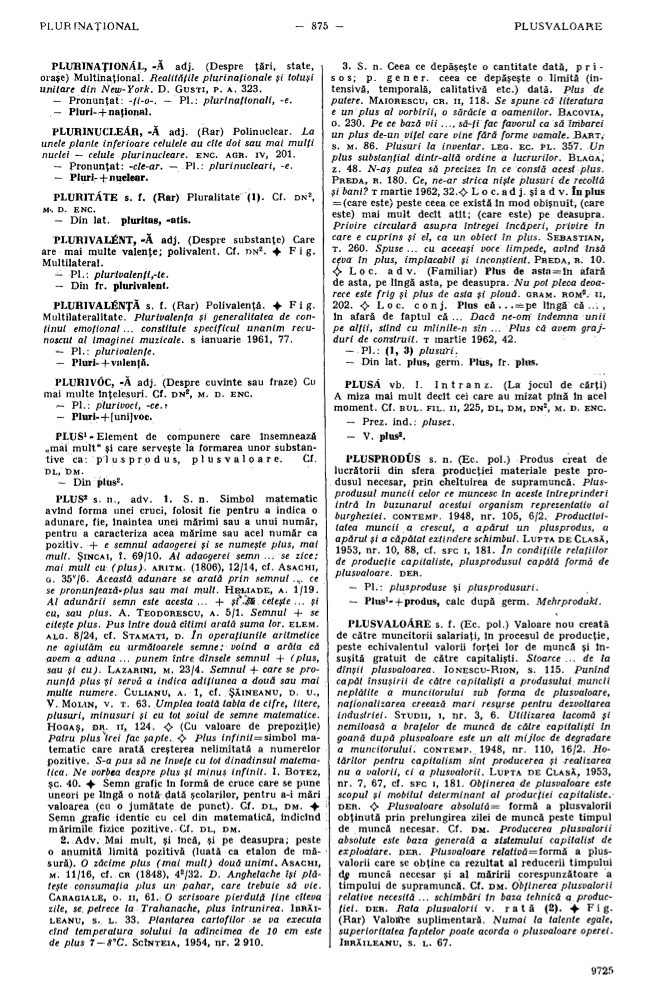
- Iorgu Iordan, Alexandru Graur, Ion Coteanu, editors (1977), Dicționarul Limbii Române, volume 8, part 3, Bucharest: Academy of the Socialist Republic of Romania, page 875
Spanish
Etymology
Borrowed from LatinCategory:Spanish terms borrowed from Latin#PLUSCategory:Spanish terms derived from Latin#PLUS plūs (“more”).
Pronunciation
- IPA(key): /ˈplus/ [ˈplus]Category:Spanish 1-syllable words#PLUSCategory:Spanish terms with IPA pronunciation#PLUS
- Rhymes: -usCategory:Rhymes:Spanish/us#PLUSCategory:Rhymes:Spanish/us/1 syllable#PLUS
- Syllabification: plus
Noun
plus m (plural pluses)Category:Spanish lemmas#PLUSCategory:Spanish nouns#PLUSCategory:Spanish countable nouns#PLUSCategory:Spanish entries with incorrect language header#PLUSCategory:Spanish masculine nouns#PLUSCategory:Pages with entries#PLUSCategory:Pages with 16 entries#PLUS
Derived terms
Further reading
- “plus”, in Diccionario de la lengua española [Dictionary of the Spanish Language] (in Spanish), online version 23.8.1, Royal Spanish Academy [Spanish: Real Academia Española], 15 December 2025
Swedish
Conjunction
plusCategory:Swedish lemmas#PLUSCategory:Swedish conjunctions#PLUSCategory:Swedish entries with incorrect language header#PLUSCategory:Pages with entries#PLUSCategory:Pages with 16 entries#PLUS
Noun
plus nCategory:Swedish lemmas#PLUSCategory:Swedish nouns#PLUSCategory:Swedish entries with incorrect language header#PLUSCategory:Swedish neuter nouns#PLUSCategory:Pages with entries#PLUSCategory:Pages with 16 entries#PLUS
- plus sign
- benefit, advantage
Declension
| nominative | genitive | ||
|---|---|---|---|
| singular | indefinite | plus | plus |
| definite | plusset | plussets | |
| plural | indefinite | plus | plus |
| definite | plussen | plussens |